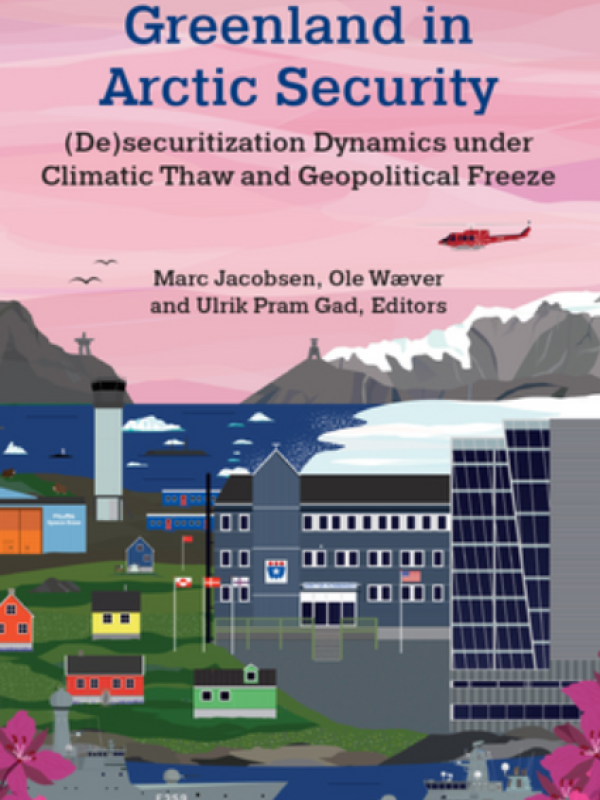
 Michaela Louise Coote, of the universities of Lapland and Galway, discusses the serious difficulties in carrying out scientific research in the Arctic against a background of major geopolitical upheaval. With Trump's claims on Greenland causing, at the very least, the induction of anxiety from Greenlandic and European leaders and citizens alike, this ‘Zone of Peace’ can no longer be seen as a reality. All evidence points to militarisation in the Arctic. But what does militarisation – including more ‘boots on the ground’, military infrastructure, funding pathways, and involvement of military alliances – mean for the research environment and, concurrently, what does this research environment mean for Arctic politics? It’s a dizzying mix.
The Arctic in (and out of) a Zone of Peace
Coined by Soviet President Gorbachev in 1987, the Arctic has long been viewed as a Zone of Peace, characterised by cooperation and dialogue despite broader geopolitical tensions, a concept often described as Arctic exceptionalism.This idea holds that the unique environmental conditions, shared challenges, and strong scientific and Indigenous cooperation in the region have encouraged states to prioritise collaboration over conflict, setting the Arctic apart from other areas of international politics.
As an Arctic researcher, with over ten years of experience in Arctic research, I have seen a lot of changes within the research environment. When I completed my Masters at the University of Iceland in 2014, Arctic research was an exciting and burgeoning field which brought together researchers, policy-makers, Indigenous leaders and more, with a spirit of collaboration on topics concerning environment and society. This spirit of collaboration led to the creation of large conferences, such as the Arctic Circle Assembly in Reykjavik with over 2,000 attendees every year. The mood was exciting and innovative as international leaders mingled with Indigenous leaders and researchers.
The Arctic Council
This would not have been possible without the achievements of the Arctic Council, the region's premier decision-shaping organisation for the region. Established in 1996, with a mandate to exclude military matters, the Arctic Council was considered the main intergovernmental forum for cooperation on Arctic issues, bringing together the eight Arctic states, Indigenous organisations, and observers to address environmental protection, sustainable development, and scientific research.
Furthermore, confidence building mechanisms, carried out through endeavours such as Academic Summer Schools were actively funded and encouraged by the Arctic States – including Russia. This included the International Summer School at the University of Oslo and the Calotte Academy, as well as national bilateral partnerships such as the Barents Arctic Network on Higher Education and Research.
However, the Council was paused after the Russian invasion of Ukraine in 2022. Russian colleagues could no longer attend conferences in Europe and North America due to visa issues and researchers could no longer go to Russia due to institutional constraints. Any Russia-West contact was actively discouraged through institutional mandates and academic norms. This led to the sidelining of non-aligning opinions, from within and outside of institutions, highlighted by the sacking of a Finnish university professor after a research trip to a conference in Russia.
Despite previous ‘friendship-building activities’ and work towards an Arctic discourse promoting a Zone of Peace, it was clear that the system could not hold. This could perhaps be attributed to the research landscape including the pausing of the Arctic Council and boycotts on collaborative research enterprises between Russia and the West. Notwithstanding the fact that Russia's war of aggression in Ukraine was terrible and should by no means be supported – it could be argued that the pause of the Arctic Council in 2022 went against the institution’s mandate to exclude military matters because this decision was also a statement about a war. The Arctic Council has slowly made moves to reignite collaboration, but this has been very tentative. In 2024, for example, Russia paused financial contributions due to the reduced pan-Arctic cooperation.
In Europe today, money is being poured into military research concerning topics on cooperation while universities increasingly forge relationships with military bodies. For example, Campus Total Defence, “a Strategic Collaboration to Strengthen Sweden’s Total Defence” brings together 37 of the country’s 50 higher education institutions to strengthen Sweden’s crisis preparedness and long-term military capability.
While researchers and journalists alike are highlighting Trump's recklessness in Greenland, and how this threatens E.U. values, especially in regards to Greenland's sovereignty and independence, we don't have Arctic exceptionalism anymore and we don't have a Zone of Peace. So the USA is not breaking Arctic norms as these were already shattered in the fall-out from the Russian war in Ukraine. But important questions remain – what will the Arctic Council do now? Would it be hypocritical to continue to work with the USA even if the only result of Trump's actions is anxiety? The discussion is not easy. Putin did actually attack Ukraine while Trump has, so far, only made threats.
Anxiety: what’s the result?
We therefore need to ask more questions about the role of anxiety in the military-politics-research nexus. As Danish Foreign Minister Rasmussen said: "It is not easy to think innovatively about solutions when you wake up every morning to different threats". Is that a clear pointer to the direct impact of anxiety on militarisation? In Arctic research, we are no strangers to anxiety. During the Cold War, researchers were fearful of their Russian counterparts and some have described this era as like living in constant fear and threat. Today, since the 2022 invasion, this fear has re-emerged. Researchers working on political topics such as science diplomacy and politically sensitive technologies report harassment – additional stops at airports, strange conversations, and people following them. But whether this is paranoia induced from a culture of fear induced from historic events or reality, it is hard to say.
This leads me to draw parallels with McCarthyism. McCarthyism was a period in the 1950s marked by intense fear of communism in the USA. It involved accusations of communist sympathies, blacklisting, and fear-driven political witch hunts that suppressed dissent.1While political oppression was more overt including mass sackings and court trials, the result was the same as Trump’s second term – a culture of fear resulting in anxiety.
Trump-based anxiety (which is an emerging concept) is not just within the research environment. The Trump Administration’s decision to remove America from international treaties and organisations causes potential havoc in the international order causing insecurity for politicians and researchers alike.
Positionality in Arctic research
Considering the historical impacts of politics on research which can be seen through McCarthyism during the Cold War, the pausing of the Arctic Council in 2022, and the creation of a somewhat oppressive Arctic research environment through institutional mandates etc, now is a good time for those contained within the military-politics-research nexus to reconsider our positionality and the impacts of this positionality on the wider political environment.
Patterns suggest that militarisation in the region is likely to continue, strengthened by increased presence by non-Arctic states in response to Trump's actions contrasting with the fragile attempts of the Arctic Council to reignite collaboration. At the very least, Trump generates anxiety in the Arctic and Europe. While academic contributions on Greenland may foster dialogue and understanding, they can also be mobilised in support of military-oriented agendas or narratives that sideline human and environmental security, a risk heightened by Greenland’s resource politics, colonial history, and semi-autonomous governance.
If science is a global public good, then perhaps now is a good time for researchers to consider the difficult question of defence vis-à-vis demilitarisation in Arctic research. I argue that there must be room for both discussions in research.
Michaela Louise Coote
PhD Candidate at the University of Lapland, Finland, and Research Associate at the University of Galway, Ireland.
Article from 'Responsible Science journal' #8, Spring 2026. Advance online publication 27 January 2026.
